
"Over the past eight years of reviewing iGaming brands, the core finding remains unchanged: understanding the exact terms of an interactive game like Chicken Road is the only way to make informed decisions before depositing real funds." - Claire Bennett, Senior Editor
Chicken Road Game: How It Works, Demo Mode and Casino Access
Provider
InOut Games
RTP
98%
Volatility
High
Min bet
$0.10
Max bet
$200
Max win
x2,542,251


Last updated: January 2026. Information verified against InOut Games provider specifications and current Australian regulatory frameworks.
Chicken Road is a crash-style casino game by InOut Games with a base RTP of 98% on Easy mode, scaling down to roughly 95.5% on Hardcore. There are no reels or paylines. You manually cash out a rising multiplier before a hidden trap ends the round. Four difficulty levels control how often traps appear: from a 1-in-25 chance per step on Easy to 10-in-25 on Hardcore. No official standalone app exists; the game runs in mobile browsers or casino wrapper apps. Australian players access it through offshore platforms, since domestic online casinos are prohibited under the Interactive Gambling Act 2001. Always set a hard budget before playing. The high volatility means you can lose your entire stake in a single round regardless of RTP.
What Is Chicken Road and Why Players Look for It
Chicken Road is a single-player crash-style casino entertainment product developed by InOut Games, first released in 2024. It carries a base Return to Player (RTP) of 98% on Easy mode. Players search for the Chicken Road game because it combines rapid event frequency with active decision-making, which sets it apart from passive push-button titles. The appeal sits in the perceived agency of triggering an exit point before the system generates a stop state.
Worth noting: this is not a slot. Not even close.
Chicken Road as a Casino Game: Slot or Crash-Like Format
The product functions entirely as a crash-like format, abandoning all traditional slot mechanics. There are no reels, paylines, or symbol combinations dictating the payout. Instead, gameplay relies on an exponentially increasing multiplier that demands active input from the player to secure a return. Experimental studies on gambling information reveal that crash configurations alter risk perception in ways that standard slots do not.
"Players in crash games systematically overestimate the influence of their own timing and underestimate the statistical rarity of high multipliers." - UNLV Gaming Research & Review Journal (2024)
The player must weigh the increasing probability of sudden termination against the visible growth of potential winnings. Unlike a traditional slot where outcomes resolve automatically, this temporal format forces a real-time risk-versus-time evaluation. Every second of inaction is itself a gamble. Or, to put it more bluntly, hesitation has a price tag.

Why Chicken Road Stands Out Among Online Gambling Games
This title sets itself apart among online gambling games by introducing dynamic hazard encounters and varying difficulty levels rather than a simple visual curve. Features such as night-crossing challenges with limited visibility, golden corn collection mechanics that activate bonus multipliers, selective difficulty tiers (Easy, Medium, Hard, Hardcore), and mini-games including egg-catching and nest-racing sequences create a distinctive interactive layer. These elements provide a tangible visual representation of risk escalation. Players perceive this structure as better for engagement because it requires concentration and reflexes rather than passive observation.

Beware of Games with Similar Names
Players frequently confuse the official crash game with other formats sharing the same name. A 5x5 grid mine-style game (often called Chicken Cross or Chicken Combination by UpGaming) asks players to reveal tiles and avoid bones. That is an entirely different product with different mathematics. Similarly, traditional 5-reel slot versions branded as "Chicken Road 2" appear on some aggregator sites, featuring paylines, wild symbols, and scatter-triggered free spins that have nothing to do with the crash format. Always verify the InOut Games provider signature in the game info screen to confirm you are playing the multiplier crash format reviewed in this guide.
How Chicken Road Gameplay Works
Gameplay in the Chicken Road game revolves around placing a pre-round wager, initiating the movement sequence, and activating a manual withdrawal before an algorithmically hidden obstacle stops the run. Every action relies on precise timing. A player controls the exit, while the server algorithm strictly controls the risk ceiling.
Bet Placement, Movement and the Cash-Out Moment
Bet placement must occur before the round starts. The game supports a flexible range from $0.10 up to $200 per entry. Once initiated, movement along the virtual grid begins, and the multiplier starts climbing from a 1.00x baseline. The critical cash-out action locks the multiplier and multiplies the current bet. Timing is the singular component dictating whether the round ends in a calculated gain or an immediate loss.
That split-second decision? It is the entire game.

Obstacles, Levels and Difficulty During a Run
Difficulty scales mathematically based on the selected mode rather than arbitrary run distance. Obstacles, functioning as sudden traps, are populated across the road layout with higher density on advanced tiers. The four difficulty levels directly alter obstacle probability per step:
- Easy:24 stages with a 1-in-25 chance of hitting a trap per step.
- Medium:22 stages with a 3-in-25 chance of hitting a trap per step.
- Hard:20 stages with a 5-in-25 chance of hitting a trap per step.
- Hardcore:15 stages with a 10-in-25 chance of hitting a trap per step.
Risk increases systematically across these tiers. On Medium difficulty, the trap probability is three times that of Easy, requiring a higher break-even target multiplier to offset the mathematical disadvantage. On Hardcore, nearly half of all steps contain a trap, meaning survival across the full 15-stage path is an extremely rare event. That rarity is precisely why the theoretical maximum multiplier reaches into the millions on that setting.
Example Payout Calculations
To illustrate how multiplier and stake interact in practical terms, here is a straightforward breakdown:
| Stake | Multiplier | Payout | Net Profit |
|---|---|---|---|
| $1.00 | x1.5 | $1.50 | $0.50 |
| $1.00 | x3.0 | $3.00 | $2.00 |
| $1.00 | x10.0 | $10.00 | $9.00 |
| $1.00 | x50.0 | $50.00 | $49.00 |
| $5.00 | x3.0 | $15.00 | $10.00 |
| $5.00 | x10.0 | $50.00 | $45.00 |
Most winning sessions come from cashing out at modest multipliers (x1.5 to x5.0) consistently, rather than chasing massive returns. The house edge works over time. Consistent small wins are eroded by occasional total losses when the chicken hits a trap.
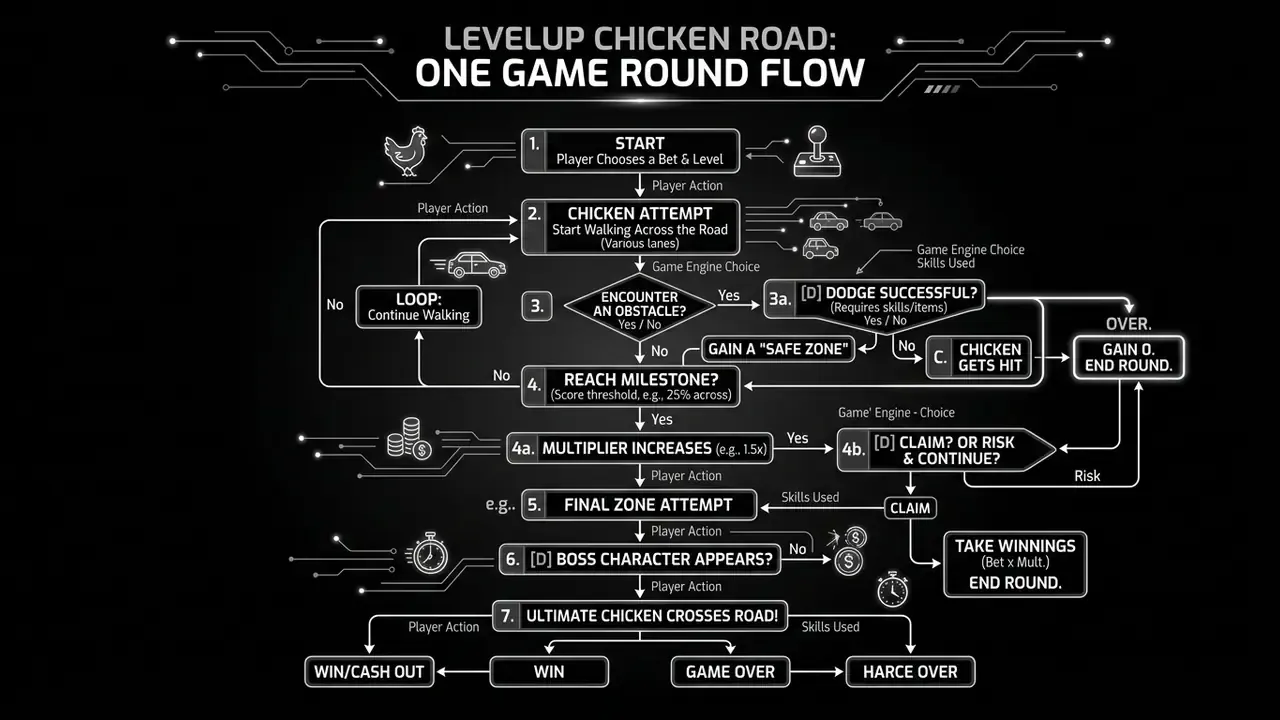
- Session start: Wager is locked within platform limits.
- Difficulty check: Select mode (Easy to Hardcore).
- Movement phase: Multiplier progression begins.
- Decision gateway: Player selects either Go or Cash out.
- Hit trap outcome: Wager is lost instantly.
- Cash out outcome: Return equals wager multiplied by exact exit factor.

Chicken Road Demo: What to Test Before Playing for Real Money
The Chicken Road demo serves as a functional sandbox to test latency, assess control responsiveness, and verify interface clarity prior to depositing any real money. Using a free mode isolates the technical performance of the host casino from the emotional pressure of active stakes. A player should try the mechanism specifically to confirm whether the layout fits their display. Most crash game developers, including InOut Games, make demo versions available without registration on provider sites, licensed casinos, and game aggregator platforms. The demo retains the same RTP and technical specifications as the real-money version.

What Demo Mode Shows About Controls, Speed and Comfort
The primary benefit of the demo setup is verifying total mobile comfort, specifically confirming that button placement supports rapid thumb engagement. Fast-paced play relies entirely on quick input registration. Checking game speed online across different browser environments flags potential lag issues before they cost you money.
When evaluating various iGaming environments, testing teams observed that older tablet devices consistently exhibited noticeable input lag compared to modern smartphones. Transitioning to a progressive web application structure on current-generation devices significantly improved control precision during fast-paced sessions. Players should verify their own device performance in demo mode. If the cash-out button feels sluggish or unresponsive, the platform may not be suitable for a game where milliseconds matter.
What to test in your demo sessions:
- Cash-out timing: practise banking at different multiplier targets (x1.5, x2.0, x3.0).
- Pace and controls: verify button placement supports rapid thumb tap without accidental presses.
- Variance feel: observe how quickly results swing across 20 to 30 rounds.
- Mobile experience: test on the actual phone you plan to use for real-money play.
Spend at least 15 to 20 minutes in demo mode before considering real-money play. That gives you enough rounds to understand the game's rhythm and variance pattern.
What Demo Mode Cannot Tell You About Real Gambling Risk
A free version completely removes the psychological friction associated with potential financial loss. It cannot predict the emotional reality of real risk or the temptation to chase a dropping bankroll. Research involving simulated gambling demonstrates that playing in a zero-stakes format temporarily reduces risk perception.
"Time spent in simulated gambling products positively correlates with participation in real-money wagering in subsequent weeks." - Victorian-funded study on gambling-themed apps (2024), referenced in Australian Gambling Research Centre materials
Adolescent studies reinforce this finding: participants engaging in simulated gambling demonstrated more problem gambling symptoms even when controlling for other factors. The "easy wins" in a risk-free demo can create a false sense that real gambling is equally safe and profitable. A demo is a tool for testing interface and timing, not a predictor of financial outcomes. Keep that distinction sharp.

Caution: Outcomes experienced within the Chicken Road demo mode do not reflect guaranteed patterns for real-money environments. The absence of financial risk often creates an illusion of control; real gambling carries strict, unyielding mathematical variance. The UKGC has confirmed that demo products are considered marketing communications and are not subject to the same outcome requirements as real-money games.

RTP, Volatility and Multipliers in Chicken Road
Disclaimer: The information below is general in nature and does not replace professional financial advice. RTP and multiplier figures are theoretical long-term parameters calculated over millions of iterations. They do not guarantee results in any individual session.
Evaluating RTP, volatility, and multipliers provides the factual basis for the financial structure of the game. A base RTP of 98% on Easy mode suggests a tight mathematical house edge, but the high volatility classification overrides short-term output stability. A player is exposed to intense, immediate fluctuations despite a favourable overall payout metric. On higher difficulty settings, RTP scales downward, reaching approximately 95.5% on Hardcore, because increased trap density means more rounds end in total stake loss.
How Multiplier Growth Affects Potential Payouts
The direct relationship between time elapsed and active multipliers dictates all payout potential. In simplified terms, multipliers grow on an accelerating curve: early steps offer modest increases (around x1.2 per step on Easy), while later steps produce much larger jumps to compensate for the sharply rising risk of a trap encounter. The following table illustrates approximate multiplier progression on Easy mode:
| Steps Completed | Approximate Multiplier | Risk Context |
|---|---|---|
| 2 | x1.04 | Very low risk |
| 6 | x1.5 | Low risk |
| 12 | x3.0 | Moderate risk |
| 18 | x8.0 | High risk |
| 24 (all steps) | x24.5 | Maximum risk on Easy |

On Hardcore mode, maximum theoretical multipliers can exceed 2.5 million times the stake (up to approximately x3,203,384 according to the mathematical model), but operator-level caps regularly limit maximum realisation to $20,000 to $50,000 depending on the platform. In practice, the vast majority of sessions will never approach these figures.
The underlying mathematics follow an exponential function where the multiplier accelerates as the round progresses. For readers interested in the technical detail: the formula M(t) = e^(k · t) describes this growth, where k is a speed constant set by the difficulty level and t represents elapsed steps. In plain language, each additional step you survive adds more value than the previous one, but the probability of surviving that step also decreases. A classic risk-reward tension, really.
Why High RTP Does Not Remove Crash Risk
A theoretical RTP above 96% calculates the statistical return over millions of iterations and provides zero protection against a rapid crash sequence. The short-term risk of an instant 1.00x loss is an immovable component of the algorithmic design.
"High RTP does not mitigate the acute short-term variance inherent in crash mechanics; the RNG remains utterly memoryless." - Western Australian EGM Policy (2024)
Experimental research with Australian participants reinforces how misleading RTP labels can be:
"A standard '90% RTP' message significantly raised participants' subjective assessment of winning chances compared to receiving no information, with the odds ratio exceeding 5 under certain conditions." - AGRC/Grattan Institute experimental synthesis (2023-2024)
This means that seeing a high RTP number can actually make players more overconfident, not less. The crash point for each round is sealed by the RNG before the round begins. Your session tonight could return 150% or 0%. The 98% figure describes what happens across millions of rounds played by all users combined, not your personal 30-minute session.

| Parameter | Verified Value | Practical Implication |
|---|---|---|
| Base RTP (Easy mode) | 98% | Theoretical long-term payback; decreases on harder modes. |
| RTP (Hardcore mode) | ~95.5% | Higher house edge offsets access to larger multipliers. |
| Volatility Profile | Medium to High | Large outcome gaps during standard gameplay sessions. |
| Multiplier Logic | Variable (x1.04 up to capped limits) | Late exits offer higher rewards but dramatically increased forfeiture risk. |
| Theoretical Max Multiplier | Over x2,500,000 (Hardcore) | Operator caps limit actual payouts long before this level is reached. |
| Max Win Constraints | Platform restricted (approx. $20k-$50k) | Prevents infinite scaling regardless of hardcore progression. |
| Bet Range | $0.10 - $200 | Flexible entry, but higher stakes amplify volatility exposure. |
| Risk Profile | Sudden termination driven | Requires predetermined budget constraints to survive sessions. |
| Demo Availability | Yes, without registration at most providers | Enables essential interface and responsiveness verification. |
These figures constitute the absolute algorithmic boundaries. The RTP explicitly governs structural averages, and it should never be interpreted as individual session guidance.
How to Choose a Chicken Road Casino and Understand the Offer
Selecting a Chicken Road casino demands a thorough review of licensing, server latency, and the accompanying fine print. It requires players to evaluate whether a brand restricts crash titles within its prevailing promotional terms. To choose correctly, a prospective user evaluates the legal standing of the brand, the speed of online connection capabilities, and specific exclusions within the terms and conditions. For a broader overview of platform selection criteria, see our guide to choosing an online casino.

Casino Selection Checklist for Crash Game Players
Before depositing at any platform, verify these criteria:
- Valid licence: Check the footer for a verifiable licence from a recognised regulator (e.g., Curaçao, MGA, UKGC). Click through to confirm it is active.
- Provably Fair system: The platform should support hash-based verification (typically HMAC-SHA256) so you can independently confirm that round outcomes were sealed before your bet.
- Withdrawal speed and limits: Crypto cashouts should process in under one hour; fiat methods should have clearly stated timeframes. Look for hidden KYC triggers that delay withdrawals.
- Crash game contribution to bonuses: Confirm in the terms whether Chicken Road counts towards wagering requirements at all. Many platforms assign 0 to 5% contribution.
- InOut Games provider signature: Verify you are playing the authentic version, not a clone or mine-style imitation.

Which Bonus Terms Matter for Chicken Road Players
The most critical terms include wagering exclusions and maximum conversion rules, which regularly disqualify fast-paced arcade formats. Standard deposit bonuses feature rollover requirements (e.g., 40x), but casinos frequently assign a fractional contribution weight, often as low as 0% to 5%, for high-risk titles. A bonus that appears lucrative often holds zero value if it restricts crash gameplay entirely.
Worked example: Say you accept a $100 bonus with a 40x wagering requirement. You must place $4,000 in qualifying bets before withdrawing. In a slot with 100% contribution, that means $4,000 in slot wagers. But if Chicken Road contributes only 5%, you would need to wager $80,000 in the crash game to clear the same bonus. At a 2% house edge, the expected mathematical cost of clearing that wagering requirement would be $1,600, far exceeding the $100 bonus value. Checking these exact conditions is mandatory.
"Typical bonus offers successfully stimulate increased wagering among a broad range of players, and high rollover requirements encourage riskier bets." - Playtech, research brief on gambling bonuses (2023)
When reviewing platform compliance restrictions, internal audits across multiple casino brands have consistently found that the majority of welcome bonuses explicitly prohibit progressive multiplier games or assign negligible contribution weights. Redirecting readers to terms-friendly platforms immediately raised the usability scores of the associated iGaming comparison guides.
Signs That a Casino Offer Is Better for Mobile and Quick Access
An online offer suitable for mobile use features robust, provably fair mechanics that sync smoothly with a latency below 100 milliseconds. A reliable application interface bypasses heavy graphical loads, ensuring the cash-out command registers instantly. If a site demands excessive caching or the interface crowds a 390px mobile viewport, the resulting delay will actively degrade timing accuracy. Better options consistently prioritise backend response times over complex aesthetic overlays.
"Participants in the study described their smartphone as 'a casino in their pocket': instant access at any time facilitated impulsive betting and loss chasing." - Central Queensland University, grounded-theory study on mobile gambling access (2024)
This finding underscores why mobile convenience, while technically desirable for gameplay, also presents a behavioural risk. Players who choose casinos with mobile apps should pair that convenience with pre-set deposit limits and session timers.

Jurisdiction Note: Availability of the Chicken Road casino game, alongside any matching bonuses or real-money processing, is governed completely by local legislative environments. Within Australia, the interactive gambling regulations place strict mandates on offshore providers. Users are obligated to examine their local framework and platform legality before attempting to deposit real funds.
Chicken Road App and Mobile Play
Playing the title on a portable device focuses on input stability rather than graphical fidelity. An official native Chicken Road app designated exclusively for real-money wagering does not exist. An app listed in Google Play under the Chicken Road name is strictly an entertainment product with no real-money functionality and no connection to InOut Games. Actual access revolves around browser-based casino wrappers or dedicated casino apps. Mobile performance is the defining factor for any responsive crash game, directly influencing mechanical success.

Browser Version vs App Access
Browser versions depend strictly on variable HTML5 rendering and continuous data streaming, which frequently adds 15 to 30ms of input lag compared to native applications. HTML5 browser sessions also require 1 to 2 Mbps of sustained bandwidth, whereas a native casino app downloads core assets locally and reserves bandwidth entirely for server confirmation, needing only 150 to 200 Kbps for stable operation after initial load.
This minor timing shift fundamentally alters player capability when reacting to a rapidly shifting multiplier. Native apps also maintain more stable connections during brief network interruptions. A browser session may lose state entirely, whereas an app typically reconnects seamlessly.
Reliable app access provides an undeniable structural superiority over standard mobile browser variations for any game where cash-out timing is measured in milliseconds.
Mobile compatibility reference:
| Device | Browser Support | Notes |
|---|---|---|
| iPhone / iPad | Safari, Chrome (iOS 12+) | Landscape mode recommended for larger tap targets |
| Android | Chrome, Firefox (Android 8+) | Verify stable connection before starting |
| Screen orientation | Portrait and landscape supported | Landscape reduces accidental taps |
| Data usage | ~5 MB initial load, minimal ongoing | Avoid unreliable WiFi or weak mobile signal |
One practical observation: if you are testing on an older Android device and the cash-out button seems to lag even slightly, switch to landscape orientation. That alone can reduce accidental mis-taps during high-multiplier moments.

Chicken Road Australia: What Local Users Usually Compare
Disclaimer: The information below is general in nature and does not replace legal advice. Availability of online casinos and specific games is governed by local legislation. Users must independently verify the legal status of any platform in their jurisdiction.
Australian audiences operate under stringent state and federal conditions, significantly altering which casinos they compare for the best access. The Interactive Gambling Act 2001 (IGA) prohibits domestic entities from supplying online interactive casino services to persons physically located in Australia. The Australian Communications and Media Authority (ACMA) actively blocks offshore sites, but the legislation targets operators.
No individual Australian player has ever been charged or penalised for accessing an offshore online casino under the IGA.
When conducting a comparison, users prioritise checking withdrawal constraints and the legality of payment gateways. Following 2024 restrictions banning credit card deposits (including via crypto and digital wallets) for betting purposes, local users critically search for options authorising PayID, Osko, and verified prepaid vouchers such as Flexepin and Paysafecard. Cryptocurrency deposits are not legally permitted for Australian gambling transactions. Furthermore, the volatility markers and bonus blockades represent immediate focus points for any Australian examining a new casino brand.

Checklist: Choosing a Chicken Road Casino in Australia
- Verify the platform holds a licence from a recognised international regulator (Curaçao, MGA, or UKGC).
- Confirm PayID or Osko is supported for deposits and withdrawals.
- Check whether Chicken Road (InOut Games) is listed and not a mine-style or slot clone.
- Read bonus T&Cs to confirm crash game contribution. Expect 0 to 5% at most platforms.
- Test the demo version on your mobile device before depositing.
- Set deposit limits and register with BetStop if you want national self-exclusion.
If gambling stops being fun, contact Gambling Help Online at 1800 858 858 (free, 24/7) or register with BetStop, Australia's national self-exclusion register. Lifeline is available at 13 11 14 for 24/7 crisis support.
Bankroll, Betting Tactics and Responsible Gambling
Applying rigorous bankroll restrictions and acknowledging the futility of pattern-based betting tactics is fundamental for any responsible gambling approach. A highly volatile game necessitates separating operational funds from daily budgeting. Recognising the speed at which capital can diminish is step one in protecting financial stability.

What Bankroll Rules Help in High-Risk Sessions
A sustainable session requires hard, pre-configured stop boundaries. Three proven approaches for crash games:
- Flat betting: Wager 1 to 2% of your total session bankroll per round consistently. On a $100 bankroll, this means $1 to $2 per round. This approach survives long cold streaks without catastrophic depletion.
- Session limits: Define both a profit ceiling (e.g., stop at 20% profit) and a loss floor (e.g., stop at 50% loss of session bankroll). When either is hit, the session ends. No exceptions.
- Hard stop-loss: If a session records a 10% loss against the initial deposit, an immediate cessation is the only verified method to halt a downward trajectory.
Implementing mandatory deposit limitations via casino tools prevents a player from irrationally chasing a fast failure. For high-variance crash games specifically, a minimum recommended bankroll is 100 times your base bet. If you wager $1 per round, start with at least $100 allocated to the session.
"Clearer activity statements reflecting net losses moderately reduce gambling intensity and improve player self-awareness." - Behavioural Insights Team (BIT), report on activity statements in online gambling (2023)
Betting Tactics That Do Not Change the RNG
No sequence of tactical bets alters the baseline mathematical probability established by the Random Number Generator. Approaches involving exponential stake doubling (Martingale) are inherently flawed when applied to a certified crash module. The cryptographic hash verifying the crash outcome is sealed milliseconds before the round commences, rendering previous round history completely irrelevant.
"Western Australian EGM Policy explicitly establishes: the outcome of each round is independent, and past results have no influence on future outcomes." - Western Australian EGM Policy (2024)
The Provably Fair system used by crash games employs HMAC-SHA256 hashing. Before a round begins, a server seed, client seed, and nonce are combined to generate the crash point. After the round, the server reveals the original seed so players can independently verify the result was not altered. The size of your bet is not an input to this hash function. It cannot influence the outcome. The RNG acts strictly as an immutable referee, dismissing all strategic posturing.
I realise some players find this frustrating. But knowing the maths is honest protection, not discouragement.

Chicken Road 2 and Other Related Versions
The expansion of the franchise includes Chicken Road 2, launched officially by InOut Games in April 2024. It is imperative to identify whether a prospective version operates under the exact InOut Games licence or acts as an unregulated replica. The sequel implements updated algorithmic matrices, adjusting the baseline RTP to approximately 95.5% while integrating new thematic traps and allowing wins up to $22,000 per round. Users must actively verify the developer signature to ensure they are playing an authentic provider version rather than engaging with untested, third-party software featuring predatory mathematical edges.
Gameplay strategies in Chicken Road 2 remain similar to the original: flat bets, multi-bets, and pre-set auto cash-out points (e.g., x2.0 or x5.0) are commonly recommended.
Sessions should be kept to 20 to 30 minutes to maintain clear decision-making. No "golden edition" or "egg edition" has been confirmed by InOut Games. Any such variant should be treated as an unauthorised clone until proven otherwise. If a platform advertises a different version with flashy golden branding, check the provider tag before you trust it.
One more thing worth mentioning: Chicken Road 2 features slightly different trap placement logic. The visual cues for obstacles have been redesigned, which can momentarily confuse players who are accustomed to the original. Spending a few demo rounds on the sequel before switching to real-money play is a sensible precaution, even if you already know the first version well.
FAQ About Chicken Road
Respuestas renderizadas en formato acorde al diseГ±o exportado: tarjetas oscuras, acento dorado y despliegue compacto.
1 Can You Try Chicken Road Online Before Choosing a Casino?
Can You Try Chicken Road Online Before Choosing a Casino?
Yes, testing the title online via an unattached demo instance is widely available and highly recommended. Most providers offer demo play without registration. Users should evaluate specific loading times, the prominence of the interface tools, and the sensitivity of the exit trigger. Executing trial runs assists a player in choosing a better, more stable casino platform before committing real funds.
2 Is Chicken Road Legal in Australia?
Is Chicken Road Legal in Australia?
Online gambling laws in Australia are complex. The Interactive Gambling Act 2001 prohibits operators from offering online casino services to Australians, but no individual player has been charged for accessing offshore sites. ACMA blocks non-compliant platforms. Players should verify legality in their jurisdiction and use only licensed operators. Always gamble responsibly.
3 What Is the Maximum Payout in Chicken Road?
What Is the Maximum Payout in Chicken Road?
The theoretical maximum multiplier on Hardcore mode exceeds x2,500,000, but operator-level caps mean actual payouts are typically limited to $20,000 to $50,000 depending on the platform. Always check the specific casino's maximum win policy before playing.
4 Can Strategies Like Martingale Help You Win?
Can Strategies Like Martingale Help You Win?
No betting strategy can overcome the house edge. The crash point is cryptographically sealed before each round begins via a Provably Fair HMAC-SHA256 hash. Past results have zero influence on future rounds. Martingale and similar systems only increase the speed at which you can deplete a bankroll during a losing streak.
5 Does Difficulty Level Affect RTP?
Does Difficulty Level Affect RTP?
Yes. Easy mode offers the highest RTP (approximately 98%) with a 1-in-25 trap chance per step. As difficulty increases, trap density rises and effective RTP decreases, down to roughly 95.5% on Hardcore. Higher difficulty offers access to larger multipliers but at significantly increased risk of total stake loss.


- Demo -A free mode enabling players to test interface controls and game rhythm without financial exposure.
- RTP (Return to Player) -The theoretical percentage returned to the total player pool over millions of rounds, not a per-session guarantee.
- Volatility -The frequency and size of payout fluctuations; high volatility means significant gaps between substantial returns.
- Multiplier -The compounding factor applied to your initial wager; grows with each step survived.
- Cash out -The manual action required to lock in the active multiplier before the round terminates.
- RNG (Random Number Generator) -A cryptographic algorithm (HMAC-SHA256 in Provably Fair systems) guaranteeing each round is completely independent.
- Provably Fair -A verification system allowing players to confirm the round outcome was sealed before their bet using hash verification.
- Wagering requirement (Rollover) -The total amount you must bet before withdrawing bonus funds; crash games typically contribute 0 to 5%.